
AWS expands SageMaker GPU options while cloud database operations and networking advance
AWS broadened SageMaker Studio instance availability across regions, added cross-AZ ENA Express support, and expanded Aurora DSQL. Google Cloud also introduced Gemini-powered fleet intelligence in Database Center.
Several infrastructure updates this week focused on a common theme: giving teams more capacity, more regional choice, and better operational visibility. AWS announced multiple region expansions for GPU-backed SageMaker Studio notebooks, extended ENA Express to support traffic between Availability Zones, expanded Aurora DSQL to more Regions, and added cancelled-run caching in AWS HealthOmics. Google Cloud, meanwhile, detailed new Gemini-powered capabilities in Database Center for fleet-wide database operations.
AWS adds more SageMaker Studio notebook capacity across regions
AWS announced general availability for several EC2 instance families on SageMaker Studio notebooks, expanding the set of regions where customers can interactively develop, fine-tune, test, and deploy AI models.
P6-B200 in US East (N. Virginia)
Amazon EC2 P6-B200 instances are now generally available in AWS US East (N. Virginia) on SageMaker Studio notebooks. According to AWS, these instances are powered by 8 NVIDIA Blackwell GPUs, provide 1440 GB of high-bandwidth GPU memory, and use 5th Generation Intel Xeon (Emerald Rapids) processors.
AWS says P6-B200 instances deliver up to 2x better performance than P5en instances for AI training. The company positions them for interactive development and fine-tuning of large foundation models, including LLMs, mixture-of-experts models, and multimodal reasoning models, directly in JupyterLab or CodeEditor environments.
G6e expands to Dubai, Tokyo, Seoul, Frankfurt, Stockholm, and Spain
AWS also announced general availability of Amazon EC2 G6e instances on SageMaker Studio notebooks in Middle East (Dubai), Asia Pacific (Tokyo, Seoul), and Europe (Frankfurt, Stockholm, Spain).
G6e instances are powered by up to 8 NVIDIA L40s Tensor Core GPUs with 48 GB of memory per GPU and third-generation AMD EPYC processors. AWS says they deliver up to 2.5x better performance than EC2 G5 instances. The company highlights interactive model deployment testing and interactive training use cases such as generative AI fine-tuning, plus deployment of LLMs with up to 13B parameters and diffusion models for image, video, and audio generation.
G6 expands to Dubai and Malaysia
Amazon EC2 G6 instances are now generally available on SageMaker Studio notebooks in Middle East (Dubai) and Asia Pacific (Malaysia). These instances use up to 8 NVIDIA L4 Tensor Core GPUs with 24 GB of memory per GPU, alongside third-generation AMD EPYC processors.
AWS says G6 offers 2x better performance for deep learning inference compared to EC2 G4dn instances. The company points to use cases including generative AI fine-tuning and inference, natural language processing, language translation, computer vision, and recommender engines.
P4de expands to Tokyo, Singapore, and Frankfurt
AWS also brought Amazon EC2 P4de instances to SageMaker Studio notebooks in Asia Pacific (Tokyo, Singapore) and Europe (Frankfurt). P4de instances are powered by 8 NVIDIA A100 GPUs with 80 GB HBM2e memory each, for a total of 640 GB of GPU memory.
Compared to P4d instances, AWS says P4de provides up to 60% better ML training performance and 20% lower cost to train. The additional GPU memory is aimed at workloads that train on large datasets of high-resolution data.
ENA Express now supports traffic across Availability Zones
AWS announced that ENA Express for Amazon EC2 now supports traffic between instances in different Availability Zones within a Region, delivering up to 25 Gbps single-flow bandwidth.
ENA Express uses the AWS Scalable Reliable Datagram (SRD) protocol to improve network performance. AWS says SRD delivers benefits through advanced congestion control and multi-pathing. The update is especially relevant for workloads such as distributed storage, databases, and file systems that need multi-AZ deployments for resilience. AWS notes that single flows between zones previously supported up to 5 Gbps.
For resilient architectures that span Availability Zones, this closes an important performance gap for single-flow traffic.
Aurora DSQL reaches five more AWS Regions
Amazon Aurora DSQL single-Region clusters are now available in Asia Pacific (Hong Kong), Asia Pacific (Mumbai), Asia Pacific (Singapore), Europe (Stockholm), and South America (Sao Paulo).
AWS describes Aurora DSQL as a serverless, distributed SQL database designed for always available applications with virtually unlimited scalability, high availability, and zero infrastructure management. With this expansion, AWS continues to broaden regional access for teams building distributed SQL applications.
AWS HealthOmics adds caching for cancelled workflow runs
AWS HealthOmics now supports caching completed task outputs of cancelled runs. When caching is enabled and a run is cancelled, HealthOmics stores completed task outputs in the customer’s S3 bucket so runs can be restarted from the point of cancellation.
AWS says this helps researchers, bioinformaticians, and workflow developers avoid recomputing previously completed tasks, while also making it easier to inspect intermediate files and debug workflows iteratively.
Google Cloud brings Gemini-powered fleet intelligence to Database Center
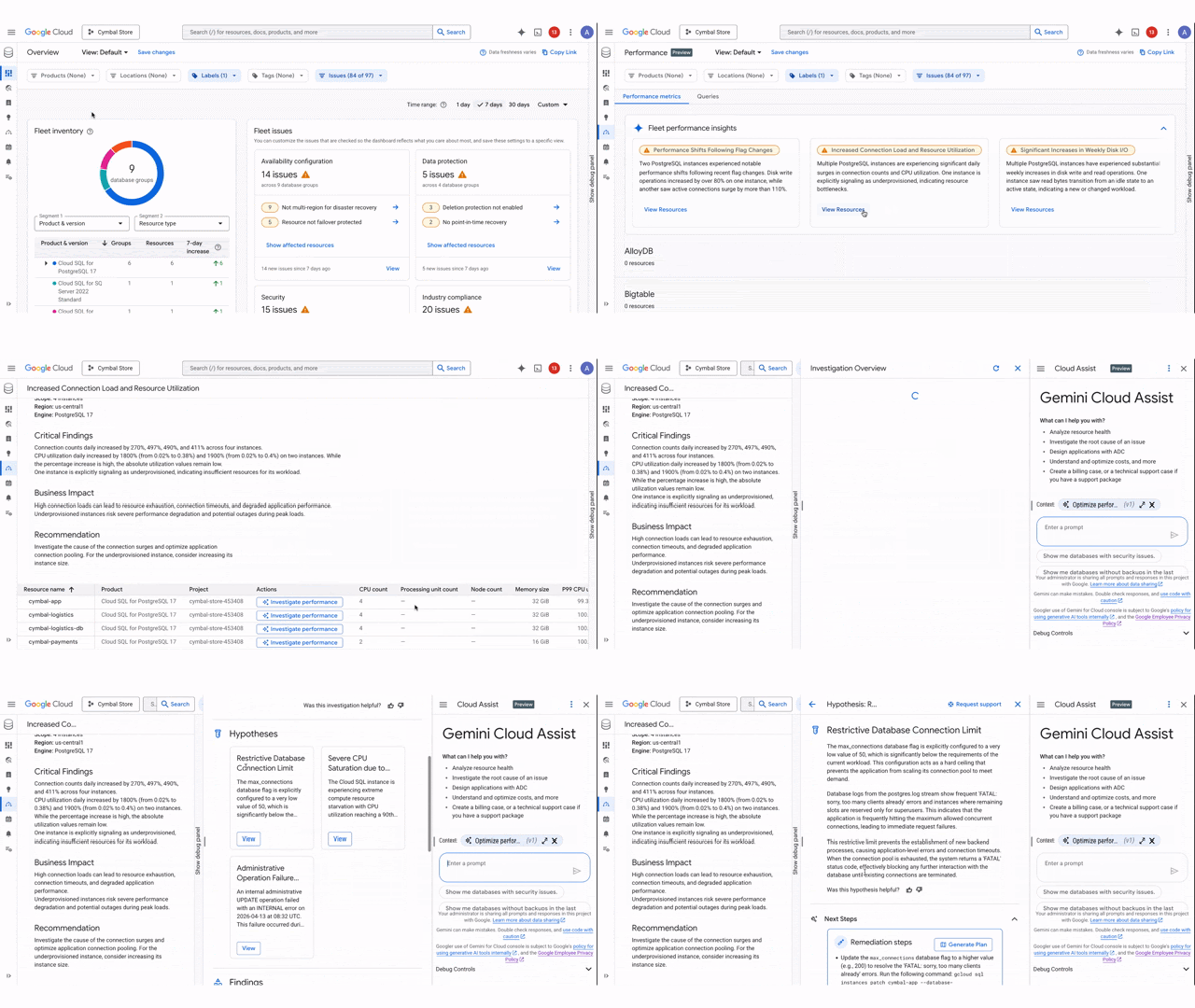
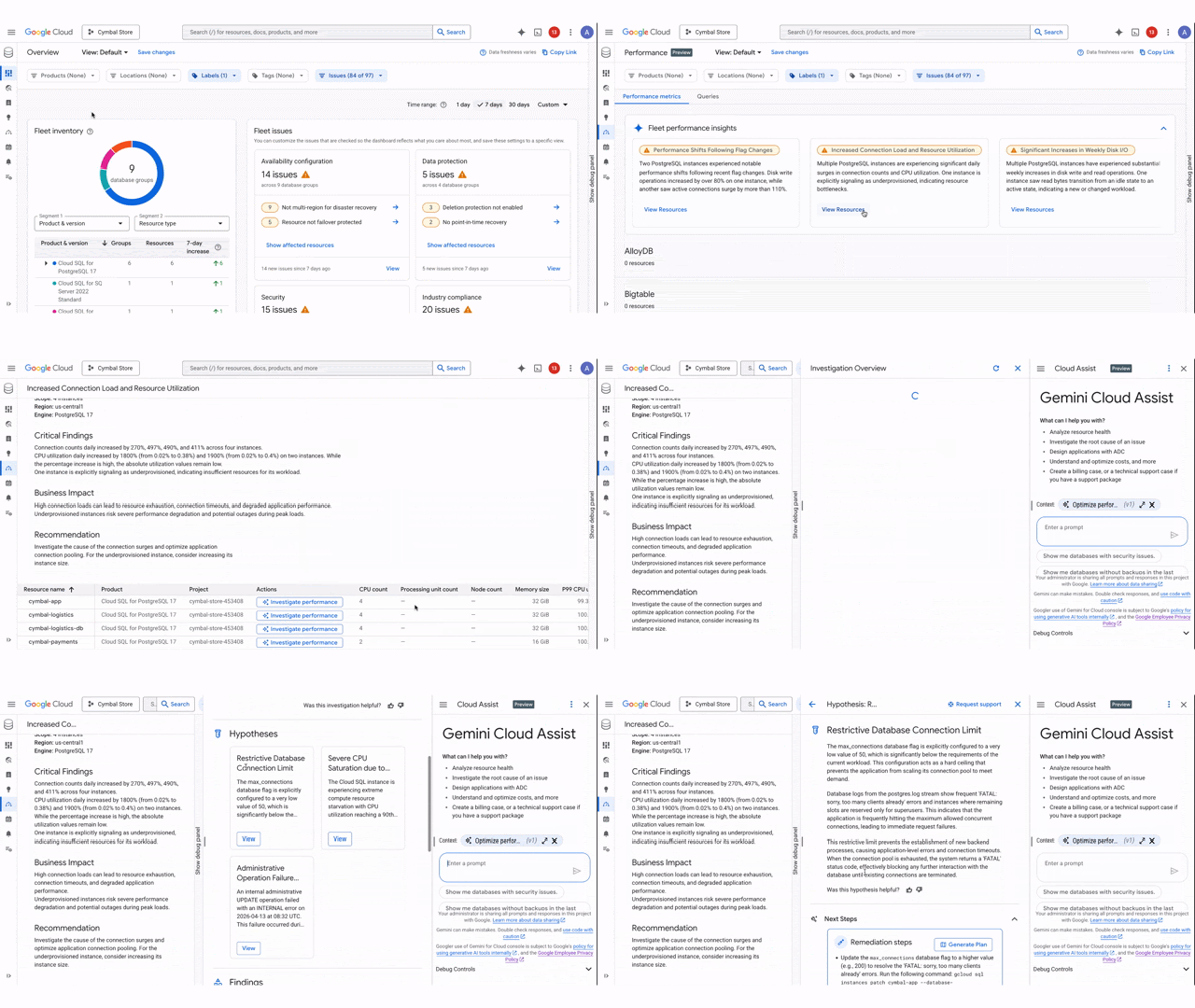
Google Cloud introduced an updated Database Center, describing it as a single pane of glass for fleet-wide visibility across Google Cloud managed database services. At Google Cloud Next ’26, the company announced an AI-native manageability interface powered by Gemini.
Google says Gemini is designed to reason across an organization’s Data Cloud and act as an expert teammate for database operations, helping replace manual scripts and fragmented troubleshooting workflows with AI-driven observability.
What stands out
- AI infrastructure is becoming more regionally available: AWS expanded multiple GPU-backed instance families for SageMaker Studio notebooks across North America, Europe, Asia Pacific, and the Middle East.
- Networking is catching up with resilient architectures: Cross-AZ ENA Express support targets an important need for distributed systems that span Availability Zones.
- Managed databases remain a strategic battleground: AWS expanded Aurora DSQL region coverage, while Google Cloud focused on AI-assisted fleet operations with Database Center.
- Workflow efficiency is getting practical attention: HealthOmics caching for cancelled runs addresses a common pain point in iterative scientific computing.
References & Credits
- AWS: Announcing Region Expansion of P6-B200 instances on SageMaker Studio notebooks
- AWS: Announcing Region Expansion of G6e instances on SageMaker Studio notebooks
- AWS: Announcing Region Expansion of G6 instances on SageMaker Studio notebooks
- AWS: ENA Express for Amazon EC2 instances now supports traffic between Availability Zones
- AWS: Announcing Region Expansion of P4de instances on SageMaker Studio notebooks
- AWS: Amazon Aurora DSQL is now available in five additional AWS Regions
- AWS: AWS HealthOmics now supports caching of cancelled workflow runs
- Google Cloud: Meet the latest Database Center, now with Gemini-powered fleet intelligence