
Cloud updates roundup: AWS infrastructure moves and Google Cloud’s AI retail and IAM push
A concise look at new AWS capabilities across VPN, EC2, Marketplace, Neptune, Bedrock, and Elastic Beanstalk, plus Google Cloud updates in virtual try-on retail AI and IAM for the agentic era.

This roundup brings together notable platform updates from AWS and Google Cloud, spanning networking, AI infrastructure, procurement automation, graph database access, agent memory, application delivery, retail experiences, and identity security.
AWS updates focused on operations, scale, and developer workflow
AWS Site-to-Site VPN can now modify tunnel bandwidth on existing connections
AWS Site-to-Site VPN now supports changing tunnel bandwidth on existing VPN connections between standard bandwidth, up to 1.25 Gbps, and large bandwidth, up to 5 Gbps. Previously, changing bandwidth meant deleting and recreating the connection, which caused new tunnel IP addresses and required updates to on-premises VPN device configuration and firewall rules.
With the new capability, AWS says tunnels can be upgraded while preserving IP addresses, CIDR blocks, pre-shared keys, and configuration settings, removing the need to change on-premises devices.
The practical benefit is simpler bandwidth changes without the disruption of reconfiguring existing tunnel endpoints.
Amazon EC2 P6-B300 instances arrive in US East (N. Virginia)
Amazon EC2 P6-B300 instances are now available in the US East (N. Virginia) Region. According to AWS, these instances provide 8 NVIDIA Blackwell Ultra GPUs, 2.1 TB of high-bandwidth GPU memory, 6.4 Tbps EFA networking, 300 Gbps dedicated ENA throughput, and 4 TB of system memory.
AWS positions P6-B300 for training and deploying large trillion-parameter foundation models and large language models. Compared to P6-B200 instances, AWS states that P6-B300 delivers 2x networking bandwidth, 1.5x GPU memory size, and 1.5x GPU TFLOPS at FP4 without sparsity.
- 8 NVIDIA Blackwell Ultra GPUs
- 2.1 TB high-bandwidth GPU memory
- 6.4 Tbps EFA networking
- 300 Gbps dedicated ENA throughput
- 4 TB system memory
AWS Marketplace adds programmatic procurement with the Agreements API
AWS Marketplace introduced the Agreements API, which lets customers procure products and manage agreements programmatically. AWS says the API can be used to generate estimates, accept offers, track charges and entitlements, update purchase orders, and manage agreements within existing tools and workflows.
Combined with the Discovery API, the Agreements API is described as enabling an end-to-end procurement journey from product discovery to purchase. AWS also notes that partners can use these APIs to build custom storefronts with unified procurement experiences.
Amazon Neptune adds 1-click connect with CloudShell
Amazon Neptune now offers 1-click connect for Neptune Database and Neptune Analytics through CloudShell. AWS says this reduces the manual network and access configuration previously required to query Neptune resources.
The new flow is aimed at reducing setup time and complexity, including for VPC-only resources. AWS highlights testing and development workflows, troubleshooting, and onboarding for customers new to Neptune as key scenarios.
Amazon Bedrock AgentCore Memory adds metadata for long-term memory
Amazon Bedrock AgentCore Memory now supports metadata on long-term memory records. AWS says this enables agents to tag, filter, and retrieve memories using structured attributes alongside semantic search.
Users can define up to ten indexed keys per memory resource, with STRING, NUMBER, and STRING_LIST types supported. Metadata can be attached at ingestion time or inferred automatically by the LLM based on extraction instructions defined on the memory resource.
AWS Elastic Beanstalk adds TLS listeners for Network Load Balancers
AWS Elastic Beanstalk now supports TLS listeners for environments configured with a Network Load Balancer. This allows teams to configure a TLS listener with an SSL certificate and security policy so the load balancer can terminate secure connections and forward decrypted traffic to instances.
AWS says this can be configured through the Elastic Beanstalk console or CLI. Previously, TLS listeners for NLB environments were not supported as a managed configuration option in Elastic Beanstalk.
Google Cloud highlights AI-powered customer experience and identity security
Breuninger uses Google Cloud for a virtual try-on retail experience
Google Cloud detailed how German fashion and lifestyle retailer Breuninger built a virtual try-on experience that lets shoppers see clothing on their own bodies using a selfie.

According to the article, the work began through Google Cloud’s Trusted Tester Program for the Virtual Try-On API, with Breuninger’s team in Germany collaborating with Google engineers in California. The post frames the effort as moving from testing to a live product intended to answer a core e-commerce question: how an item will look on a shopper.
The use case shows how generative media models are being applied directly to retail conversion and product visualization.
Google Cloud outlines new IAM capabilities for the agentic enterprise era
Google Cloud also outlined IAM updates centered on securing AI agents and modern cloud environments. The company argues that traditional identity controls are not sufficient for autonomous AI agents operating at machine speed with access to sensitive data.
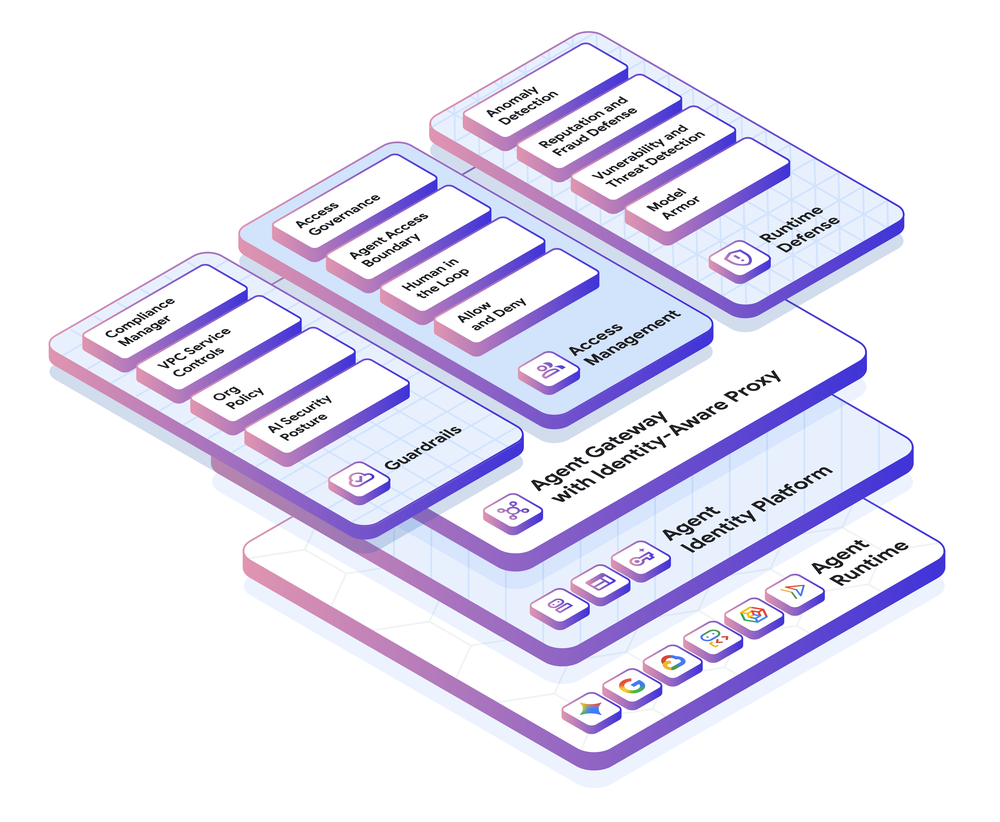
The post describes a broader framework introduced at Google Cloud Next, including Agent Identity and an Agent Gateway with Identity-Aware Proxy, along with agent access management, agent guardrails, and runtime defense.
In Google Cloud’s framing, the goal is a built-in security and governance model for the growing use of AI agents across organizations.
What stands out across these announcements
- Less operational friction: AWS is reducing manual steps in areas like VPN bandwidth changes, Neptune connectivity, and Elastic Beanstalk TLS configuration.
- More AI-oriented infrastructure: EC2 P6-B300 and Bedrock AgentCore Memory both target demanding AI workloads, from model training to memory retrieval.
- Automation in enterprise workflows: AWS Marketplace’s Agreements API extends procurement into programmable systems.
- AI moving into end-user experiences and controls: Google Cloud’s updates span both customer-facing retail experiences and back-end identity governance for AI agents.
References & Credits
- AWS Site-to-Site VPN now supports modifying tunnel bandwidth on existing VPN connections — AWS
- Amazon EC2 P6-B300 instances are now available in the US East (N. Virginia) Region — AWS
- AWS Marketplace now supports programmatic procurement with Agreements API — AWS
- Amazon Neptune now supports 1-click connect with CloudShell — AWS
- Amazon Bedrock AgentCore Memory announces metadata for long-term memory — AWS
- AWS Elastic Beanstalk now supports TLS listeners for Network Load Balancers — AWS
- Fitting the future: How Breuninger boosted sales with its "be your own model" AI — Google Cloud
- What's new in IAM: Security, governance, and runtime defense — Google Cloud