
Cloud updates this week: faster GKE startups, Gemini CLI shipping, and key AWS platform changes
Google Cloud and AWS rolled out notable updates, from up to 4x faster GKE node startup and Gemini CLI deployment help to AWS changes across VPN, DNS, contact centers, and Service Catalog.
Several infrastructure and developer-platform updates landed this week across Google Cloud and AWS, with a common theme: reducing operational friction. Highlights include faster node startup in Google Kubernetes Engine, a Gemini CLI extension aimed at shortening the path from local code to deployment, and several AWS enhancements spanning remote access, DNS, contact center workflows, and regional service expansion.
Google Cloud: speeding up deployment and runtime operations
GKE targets cold-start latency with faster node startup
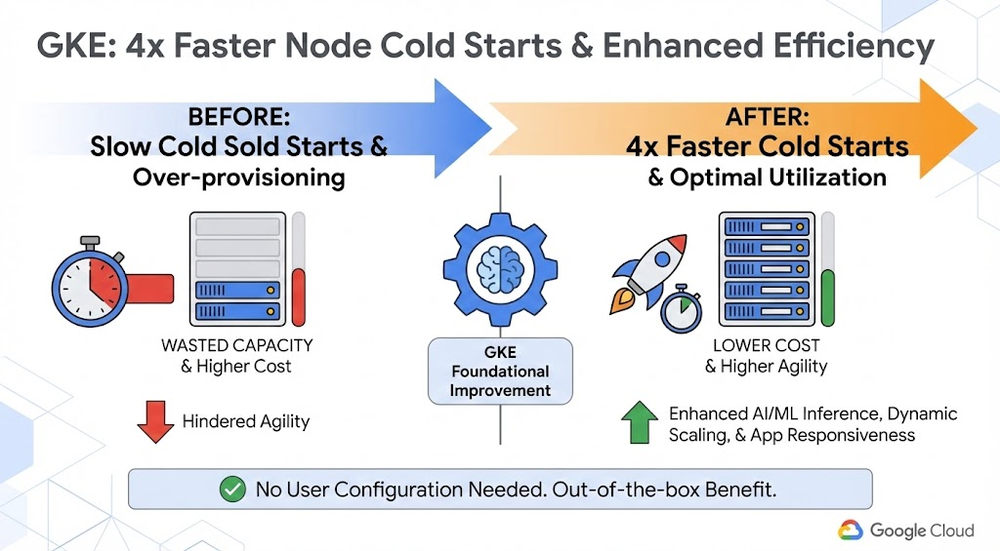
Google Cloud says Google Kubernetes Engine now delivers up to 4x faster node startup times for qualifying nodes. According to the announcement, this is an architectural improvement built into provisioning rather than a feature customers must manually enable.
The practical benefit is shorter wait times when infrastructure has to scale or come online quickly. Google highlights use cases including rapid deployment of models for AI inference as well as dynamic scaling for both accelerated and general-purpose nodes.
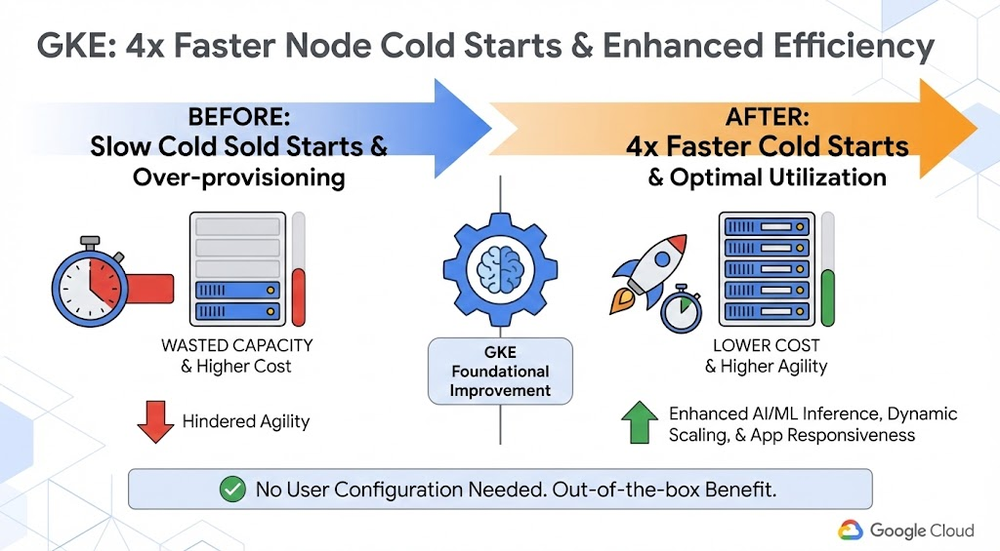
Google describes the update as an out-of-the-box architectural upgrade intended to improve agility and cost-efficiency by reducing cold-start delays.
Gemini CLI DevOps Extension aims to close the inner-loop/outer-loop gap
Google Cloud also introduced the Gemini CLI Extension for CI/CD, positioning it as a way to bridge the gap between quickly building an app locally and actually shipping it. The source article frames this as the familiar split between the fast inner loop of writing and testing code and the slower outer loop of containerization, IAM setup, and CI/CD pipeline work.
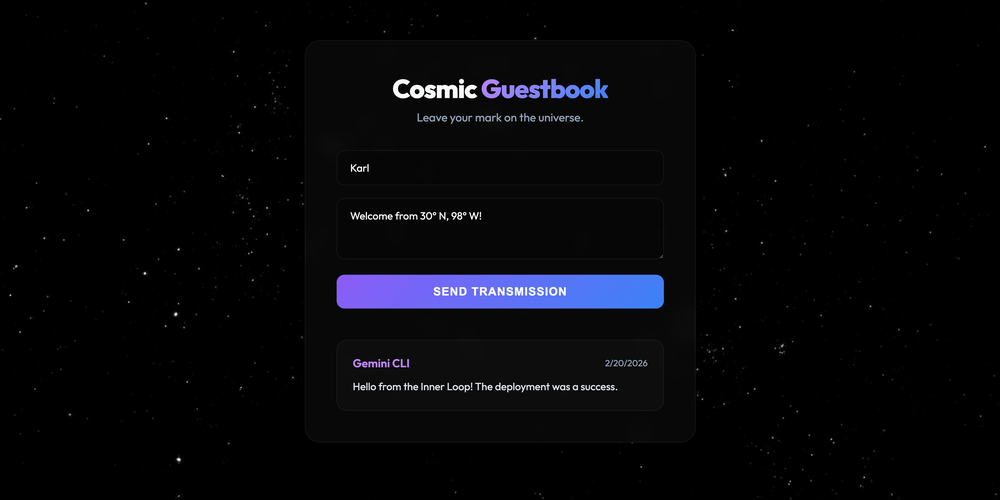
The extension is described as supporting both quick deployments and full pipeline generation from a single terminal interface, with the goal of helping developers move from a working local app to a deployed service much faster.
- Targets deployment bottlenecks after local development
- Works through a terminal interface
- Supports quick deployments and full CI/CD pipeline generation
AWS: incremental but meaningful platform improvements
AWS Client VPN adds Ubuntu 26.04 LTS support
AWS Client VPN now supports Ubuntu 26.04 LTS for its Linux desktop client. AWS says the client remains free to download and is available in all regions where AWS Client VPN is generally available, with no additional cost.
The service is designed to securely connect remote workers to AWS or on-premises networks. With this release, AWS says the Ubuntu client lineup now includes 22.04, 24.04, and 26.04 LTS. The announcement also notes desktop client support across macOS, Windows, and Ubuntu Linux, with ARM64 support for macOS and Windows clients.
Amazon Connect automates guides during After Contact Work
Amazon Connect now supports default Step-by-Step Guides for After Contact Work (ACW). This allows administrators to automatically launch a guide whenever an agent enters the ACW state, removing the need for the agent to manually open the right workflow.
AWS says this can help standardize post-contact tasks such as logging disposition codes, updating cases, and completing follow-up actions. The intended outcomes are greater consistency, fewer errors, lower handle time, and improved agent productivity.
Route 53 Global Resolver adds regional control for anycast DNS resolution
Amazon Route 53 Global Resolver now lets customers add and remove AWS Regions participating in anycast DNS resolution. AWS positions this as a flexibility improvement for organizations that need to expand coverage over time or adjust deployments to meet compliance requirements.
Importantly, AWS says customers can make these regional changes without recreating their Global Resolver configuration. The capability is available at no additional cost in all AWS Regions where Route 53 Global Resolver is supported.
- Add or remove Regions used for anycast DNS resolution
- Adjust coverage as organizational needs change
- Support compliance-driven regional deployment changes
- Avoid rebuilding the existing Global Resolver configuration
AWS Service Catalog expands to two more Regions
AWS Service Catalog is now available in Asia Pacific (New Zealand) and Canada West (Calgary). The service helps organizations create and distribute approved Infrastructure as Code products on AWS.
As described by AWS, administrators can define products using AWS CloudFormation or other IaC tools such as Terraform. Those products can then be shared across AWS accounts and organizational units through AWS Organizations, giving teams governed self-service access to approved resources.
What ties these announcements together
Across both cloud providers, the pattern is straightforward: fewer manual steps, faster provisioning, and more operational control. Google Cloud's updates focus on accelerating the path from code to running infrastructure and reducing runtime scaling delays. AWS's announcements lean toward platform breadth and workflow refinement, from endpoint support and contact center guidance to DNS control and regional availability.
None of these updates radically redefine their respective platforms on their own, but together they point to the same industry direction: cloud tooling is increasingly trying to remove the small but persistent sources of friction that slow teams down.
References & Credits
- With faster node startup for GKE, say goodbye to cold-start latency — Google Cloud
- Ship code within minutes with the Gemini CLI DevOps Extension — Google Cloud
- AWS Client VPN now supports Ubuntu OS version 26.04 LTS — AWS
- Amazon Connect adds default Step-by-Step Guides for After Contact Work — AWS
- Amazon Route 53 Global Resolver now lets you add and remove AWS Regions for anycast DNS resolution — AWS
- AWS Service Catalog is now available in the AWS Asia Pacific (New Zealand) and Canada West (Calgary) regions — AWS